Maslow's Hierarchy of Needs
Abraham Maslow was an American professor of psychology who proposed this theory in his 1943 paper, "A Theory of Human Motivation." His theory of human developmental psychology is centered around the particular stages of growth in humans. The image below is a representation of Maslow's pyramid:
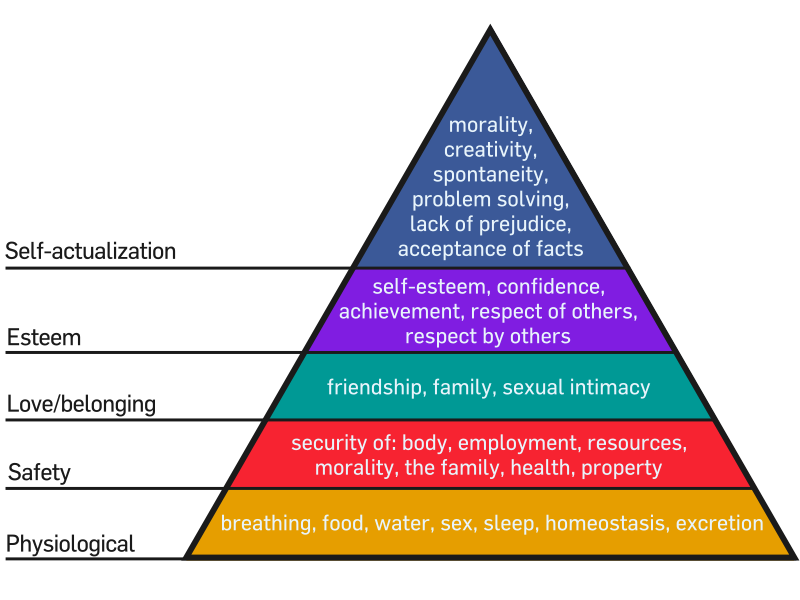
(Source: http://programs.honolulu.hawaii.edu)
Maslow breaks up the groups in critical importance with basic, instinctive needs on the bottom like food and shelter and self-actualization at the top. Once you are self-actualized, Maslow believed you are metamotivated: striving beyond the scope of fundamentals and trying to attain full potential.
However, numerous psychologists believe that as humans have evolved, so have our needs. Here is an article that gives Maslow's pyramid a "face-lift" for the current generation:
Rebuilding Maslow's pyramid on an evolutionary foundation
However, numerous psychologists believe that as humans have evolved, so have our needs. Here is an article that gives Maslow's pyramid a "face-lift" for the current generation:
Rebuilding Maslow's pyramid on an evolutionary foundation
Classical Conditioning
Behaviorism is a theory in psychology that states learning occurs through interactions with the given environment. The environment shapes your behavior and internal mental states do not affect behavior. Classical conditioning is a behavior learning theory that was discovered by Russian psychologist, Ivan Pavlov. An environmental stimulus and a natural stimulus are used in this learning process to determine what happens when outside factors trigger basic instincts.
Pavlov used unconditioned and conditioned stimuli and responses in his famous "Pavlov's dogs" experiments. He noticed that the dogs not only salivated in the presence of meat powder but also salivated in the presence of the lab technician that fed them. Pavlov used a bell to indicate the arrival of food for the dogs in an initial experiment. After a while, the dogs would salivate at the sound of the bell even when there was no food available.

One of Pavlov's dogs which is now preserved in the Pavlov Museum in Ryazan, Russia
(Source: http://psychologydegreeguide.org)
People do not actually behave like Pavlov's dogs. However, classical conditioning has real-world implications has people use them to train pets, in the treatment of phobias and anxieties, and in the teaching of new associations.
You and the Environment
How does your behavior alter your perspective on the environment and how you act towards it? There is no definite answer, but in the articles Mind the Gap! and Feelings of Responsibility for the Environment, researchers have looked into altruism, empathy, prosocial models and other venues to help determine if there is actually a connection between behavior and the environment. Personally, my adoration for the environment is a mixed bag: I act altruistically because I want to improve the environment for the people around me and their well-being. On the other hand, I love animals and all of nature itself; it would be a sad day in my life to find out that dolphins or tigers have gone extinct. There are different reasons why people would want to become involved with our Glassboro project. On the other hand, there are numerous reasons why people would not want to be a part of this group. What motivates people towards different causes is unique to each person. Whether it is for altruistic reasons or because involvement will be directly beneficial, people are motivated towards causes in dissimilar manners because, in essence, we're all special in our own ways!
So how do you act towards the environment? Do you do anything specific to preserve it on a large of small-scale?
Sources:

No comments:
Post a Comment