Monday, September 26, 2011

Actor-Network Theory

We are all inherently connected to each other by our actions and non-actions. We are even brought together through our emotions and feelings. These concepts do not seem out of the ordinary, but what would you say to not only being connected to people but to objects? Non-living things? The Actor-network theory, which is often abbreviated as ANT, is the next theory in psychology my class is researching in our endeavor of becoming better acquainted with the kind of people involved in the environmental scene. 

The Lowdown on the Actor-Network Theory
Science and Technology Studies (STS) scholars Michael Callon and Bruno Latour and sociologist John Law were the key originators of the ANT, which in essence, is not really a theory; more specifically, it is a methodological stance that researchers take when they proceed in their analysis of a situation. In the Actor-Network Theory and After, written by John Law, Law explains the basic concepts of the ANT and attacks it at all angles to show its usefulness. It does not explain why networks form; it is more interested in how networks are formed. The ANT argues that no one acts alone: there are always going to be outside factors that contribute to the results of an experiment. A better explanation for the ANT is that it is a foundation for considering the infrastructure of surrounding technological advances. Material (between things) and semiotic (between concepts) networks are joined together to form a single network that acts as a whole. Human and non-human (artifacts, organizations) entities are considered equal and are implemented into the same framework (Notes on the Theory of Actor-Network). 


Criticism
There are numerous unique critiques on the Actor-Network Theory. In this article on the Actor-Network Theory,the author elaborates on some of these. For example, ANT holds all actors equivalent, so there can be no variations made for imbalances in power among the actors. Moreover, a few disparagers consider placing importance on nonhuman actors as ridiculous and that the ANT is amoral. Most telling is that many believe that the ANT induces incompetent descriptions that do not have a valuable result or point. 


Environmental Focus?
The Actor-Network Theory considers some interesting concepts, such as placing importance on nonhuman actors and showing that nothing can be accomplished without outside influence. However, the ANT can be redundant and lead to a dead-end because of its lack of structure and rules. Actors can have differing levels of importance to each researchers and the chains of associations can be endless. Showing that we are all connected in our journey to a better future could help people become more involved since there are direct associations between a healthier environment and a healthier community. Moreover, if it is taken to an extreme, a plethora of factors can be considered joined in a network, which does not lead to a clearer picture that dictates what can be done to help our environment. Relating this to our Glassboro project, the ANT would not majorly assist in our goals. It leaves a ton of room for inconsistencies and too many things would come into play, leaving the project very disorganized. Overall, I do not believe the Actor-Network Theory is very helpful in solving our specific environmental problems.


Still a little confused? Watch ANT in Plain English

Sources:
Learning Theories
University of Colorado-Denver ANT thoughts
ANT in Plain English
Lancaster University Studies (UK)
Why Did the ANT Run Out of Steam?

Monday, September 19, 2011

Motivational Theory

Why do people do the things they do? Why do you do the things you do? Is there some kind of goal in mind? Is some force, tangible or not, acting on you to do these things? Do you just do things to feel good or to get something out of it? These are all extremely useful things to know as I progress in my Environmental Studies class and hopefully, an environmentally-centered career. Professor Fergus has asked us to study the unique theories out there that focus on people's actions and the motivations behind them.

Maslow's Hierarchy of Needs 

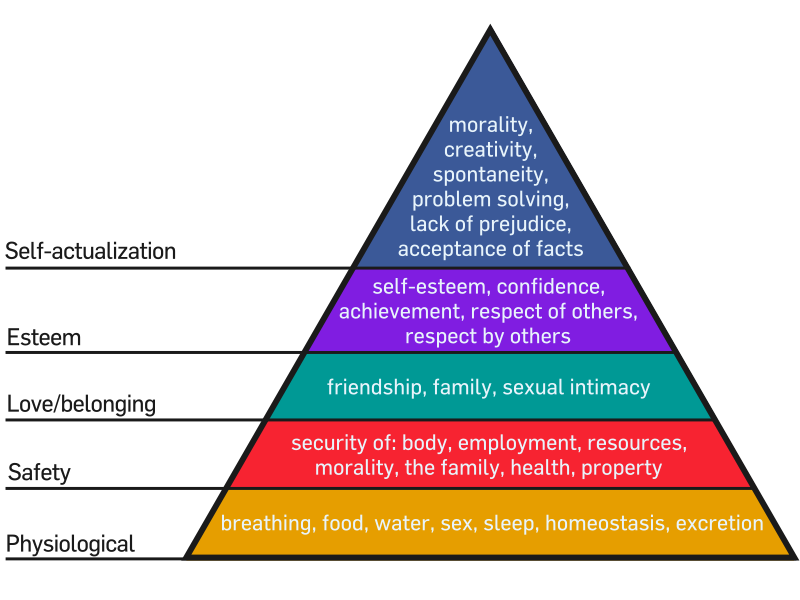
Abraham Maslow was an American professor of psychology who proposed this theory in his 1943 paper, "A Theory of Human Motivation." His theory of human developmental psychology is centered around the particular stages of growth in humans. The image below is a representation of Maslow's pyramid:

Maslow breaks up the groups in critical importance with basic, instinctive needs on the bottom like food and shelter and self-actualization at the top. Once you are self-actualized, Maslow believed you are metamotivated: striving beyond the scope of fundamentals and trying to attain full potential. 


However, numerous psychologists believe that as humans have evolved, so have our needs. Here is an article that gives Maslow's pyramid a "face-lift" for the current generation:
Rebuilding Maslow's pyramid on an evolutionary foundation

Classical Conditioning

Behaviorism is a theory in psychology that states learning occurs through interactions with the given environment. The environment shapes your behavior and internal mental states do not affect behavior. Classical conditioning is a behavior learning theory that was discovered by Russian psychologist, Ivan Pavlov. An environmental stimulus and a natural stimulus are used in this learning process to determine what happens when outside factors trigger basic instincts.

Pavlov used unconditioned and conditioned stimuli and responses in his famous "Pavlov's dogs" experiments. He noticed that the dogs not only salivated in the presence of meat powder but also salivated in the presence of the lab technician that fed them. Pavlov used a bell to indicate the arrival of food for the dogs in an initial experiment. After a while, the dogs would salivate at the sound of the bell even when there was no food available. 
One of Pavlov's dogs which is now preserved in the Pavlov Museum in Ryazan, Russia

People do not actually behave like Pavlov's dogs. However, classical conditioning has real-world implications has people use them to train pets, in the treatment of phobias and anxieties, and in the teaching of new associations. 

You and the Environment

How does your behavior alter your perspective on the environment and how you act towards it? There is no definite answer, but in the articles Mind the Gap! and Feelings of Responsibility for the Environment, researchers have looked into altruism, empathy, prosocial models and other venues to help determine if there is actually a connection between behavior and the environment. Personally, my adoration for the environment is a mixed bag: I act altruistically because I want to improve the environment for the people around me and their well-being. On the other hand, I love animals and all of nature itself; it would be a sad day in my life to find out that dolphins or tigers have gone extinct. There are different reasons why people would want to become involved with our Glassboro project. On the other hand, there are numerous reasons why people would not want to be a part of this group. What motivates people towards different causes is unique to each person. Whether it is for altruistic reasons or because involvement will be directly beneficial, people are motivated towards causes in dissimilar manners because, in essence, we're all special in our own ways!

So how do you act towards the environment? Do you do anything specific to preserve it on a large of small-scale?

Sources:

Saturday, September 10, 2011

Personality Research

In our Environmental Studies: Social Perspectives class, Professor Rob Fergus asked us to take a series of personality tests. "To know about others, you must first know yourself," he reasoned to us. Makes sense. After taking a Meyers-Briggs Test and a Big Five test, I found myself saying, "Wow, that's completely me" quite often when reading my results. Here is what I discovered about myself:


Meyers-Briggs
Extraverted- 56% 
Intuitive- 62%
Feeling- 25%
Judging- 56%
ENFJ (Teacher)


Big Five
Extroversion- 66%
Orderliness- 68%
Emotional Stability- 66%
Accommodation- 70%
Inquisitiveness- 70%


The following article shows the reader the qualities of a Teacher in the Kiersey Scale. The Temperament of an Idealist, a Teacher has the natural ability to lead and bring the best out of those around them. They consider people most important, communicate well, and love being involved. Being organized, extremely tolerant, and sensitive are other features of Teachers.
ENFJ Profile

The following links are to the specific tests I took:
Meyers-Briggs Test
Big Five Test

The article "Where is the Person in Personality Research" states that we must have the personality literature to be able to portray a person in an adequate manner or else we may be looking in the wrong place. Lastly, those who conduct these tests must be able to invest themselves in the task of discovering different personality types. Only then will we be able to accurately describe the unique individuals we encounter.


Environmental Impact
Why is this important for Environmental Studies? It doesn't seem very obvious, but your personality type determines what role you take in the environmental playing field. Those who are more extroverted will be up for going to rallies and meetings to save the environment while more introverted people may feel that recycling is the most they would do for the environment. Personality research is astounding; to know the inner workings of how your mind works is a fantastic asset as you go forward in your attempts to make our planet a little greener. Keep in mind that not everyone you encounter will be just like you and embrace it! We can save the world in so many different ways: big and small! In relation to our Glassboro project, we will be able to see how people react to environmental activism from a group of college students. Appealing to different personality types with unique forms of participation will get more people involved.


More information on personality research:
Personality Research at UM
Carl Jung's Personality Types
The Big Five Personality Dimensions
Behavior Genetics

Similar Minds: Personality Research blog